A Table for Slow Looking: An Afternoon with a Sketchbook
A slow-looking sketchbook afternoon turns familiar household forms into attentive drawing practice, with a simple plan for choosing objects, views, and pace.
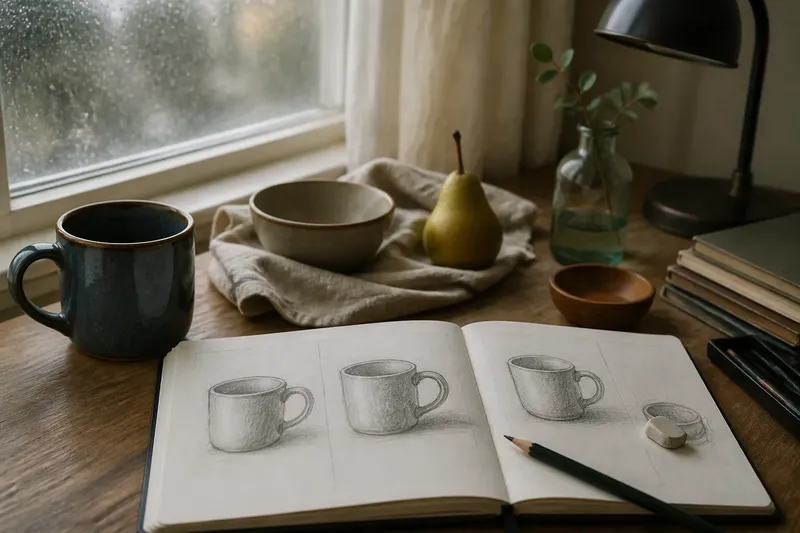
The most common mistake in a slow-looking sketchbook afternoon is trying to make a finished picture before you have really seen the object. That rush can turn a quiet rainy afternoon into a string of unsatisfying attempts. Instead, choose a few familiar household forms, draw them from changing viewpoints, and let each page record one fresh observation.
This is not a test of drawing skill or a project that needs a polished result. It is a way to spend time with ordinary shapes: a mug’s handle, a folded cloth, a pear, a small bowl. Your situation determines what to bring to the table and how to arrange it. The useful aim is simple: look again, notice what shifts, and put that change on paper.
What kind of afternoon do you have?
Start by deciding what the room and your energy will allow. You do not need to clear the whole table or gather an elaborate still life. A small, stable arrangement is easier to revisit than a display that keeps changing.
- If you want a quiet, low-effort session: Choose one object with a clear outline, such as a ceramic mug or a lemon. Keep it near a window, and draw it from your seat. Repeated looking at one form gives your attention room to settle without requiring constant setup.
- If you feel restless: Pick three objects with contrasting shapes, such as a tall bottle, a round orange, and a folded napkin. Make a new drawing after shifting your chair or turning one object. The variety gives you small decisions to make without needing to leave the table.
- If the light is changing quickly: Work with objects whose forms remain legible in softer light, such as a bowl, a wooden spoon, and a folded towel. Use the changes in shadow as observations rather than trying to preserve one lighting effect.
- If you have limited table space: Keep a single object and your sketchbook, and move the book or your chair for a new view. A clear patch of tabletop is enough; crowding it with supplies adds little to the looking.
- If you want to draw with someone else: Set one shared object between you and use separate pages. Compare what each person noticed only after drawing, so the conversation does not steer both views toward the same details.
For instance, say you have a rainy afternoon, a blue mug, and only a corner of the kitchen table free. You draw the mug from the front, then move to its handle side and draw again, noticing that the rim looks narrower from there. The visible result is not necessarily a better picture; it is a page that records a change your first glance missed.
Which objects are easiest to revisit?
Choose forms that hold still and have features you can describe without naming them as a whole. A teapot offers a body, spout, lid, and handle. A piece of fruit has a contour, stem, and uneven surface. A folded towel creates ridges and dark gaps. These details give your eye places to return.
Mixing shapes can make the arrangement more interesting, but too many objects compete for attention. Two or three are plenty for a compact tabletop scene. Look for contrasts you can observe directly: round beside narrow, smooth beside textured, upright beside low. The point is not to compose a dramatic still life. It is to give your eye a few relationships to notice.
Everyday objects also make useful subjects because you already know what they are. That familiarity can be a trap: the mind supplies a symbol for “mug” or “apple” before the eye checks the particular form in front of you. Slow down and ask what is actually visible: where the handle joins the cup, how the fruit leans, or which edge disappears against the table.
How should you set up the table?
Keep the setup comfortable enough that you can stay with it. Put the sketchbook where your drawing hand can reach it and leave a clear sightline to the objects. A pencil and a soft eraser are sufficient; colored pencils, pens, or a small box of crayons are optional. If you use a medium with care requirements, follow its label and the manufacturer’s instructions.
Choose a seat that lets you see the arrangement without leaning awkwardly. A window can provide steady, soft light on a rainy day, but you do not need to arrange the objects to match an ideal picture. If the view is dim, use a nearby lamp that does not shine straight into your eyes or cast a distracting glare on shiny surfaces.
Keep the objects where they are easy to reach, but avoid handling them between every drawing. When you do move one, make that change deliberate: rotate the bowl, turn the mug, or shift the cloth. A clear change in position gives you something specific to compare with the previous page.
It is not worth the effort to build a miniature studio, search for perfect props, or sharpen a row of pencils before beginning. A complicated setup can consume the attention you meant to give the objects. Use what is at hand and begin with the view you already have.
How do you keep looking instead of rushing?
Give each drawing one observation to hold onto. You might attend to the outline, the space inside a handle, the way two objects overlap, or the direction of a shadow. A single focus is easier to sustain than an instruction to “draw everything well.”
Before putting pencil to paper, let your eyes travel around the object. Notice where its widest part sits, which edges slope, and what seems to line up with the table or another object. Then make a light drawing and compare it with the view. If something feels wrong, look back for the reason instead of correcting by guesswork.
On the next page, repeat the subject but change one condition. Move your chair, turn the object, or select a different feature to observe. Keeping other parts of the arrangement steady makes the change easier to notice. You might draw the same bowl from a lower view, then from slightly above, and compare how much of its inside becomes visible.
Use each page as a record of attention, not a verdict on your ability. Leave in a searching line if it shows how you worked out a curve. Add a small note such as “handle behind rim” or “shadow falls toward cloth” when words capture an observation more clearly than another mark. You are making a trace of looking, and it can be loose, unfinished, or uneven.
What if a familiar object still feels difficult?
What should I draw if I cannot think of a subject?
Choose the nearest object with a clear outline, then name one part you can study: an edge, opening, fold, or shadow. Starting with a detail gives your attention a specific place to land.
What if my drawings do not look like the objects?
Pause and compare one relationship at a time, such as the handle’s height against the cup or the bowl’s width against its depth. Adjust the shape only after checking the view again, rather than trying to repair the whole page at once.
What if the light changes while I draw?
Let the changing light become part of the session and note which shadow or edge has shifted. If the change makes the subject hard to read, turn the object or move to a more stable view instead of chasing every passing shadow.
How many pages should I fill?
Stop when your attention feels used up, not when the sketchbook reaches a particular page. One careful drawing and one changed viewpoint can be more satisfying than filling pages while looking less closely.
When is it time to stop?
End when you begin repeating marks without noticing anything new, or when the arrangement no longer holds your interest. Before closing the sketchbook, look across the pages and pick one change you can name: a different silhouette, a newly noticed gap, or a clearer sense of how the objects overlap.
You do not need to select a “best” drawing. If you want a small record of the afternoon, write the date and one brief observation beside the last page. That note can help you remember what the drawing session was about without turning the sketchbook into a performance record.
A slow-looking sketchbook afternoon works best when its scale fits your real room and your real attention. Leave the objects where they are, or return them to their usual places, and keep the pages as they are. Next time, the same mug or bowl can offer another view; the useful practice is returning with a little more patience, not producing a finished picture.