Before the House Lights: How Audiences Found Their Seats
Explore theatre seating through stage layouts, sightlines, and audience positions, and learn what to notice when choosing a seat or watching a performance.
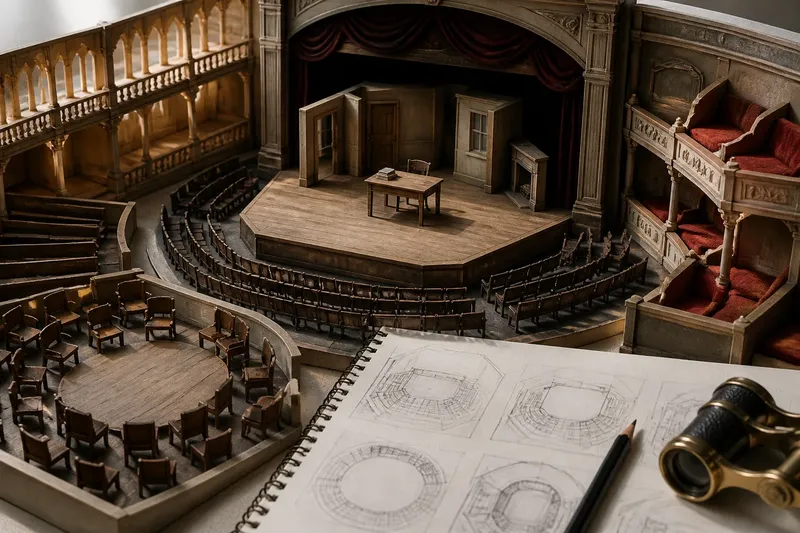
Theatre seating shapes what an audience can see, but broad claims about its history can hide important differences between buildings and periods. To understand the relationship between seats and performance, look at a particular room’s entrances, floor, galleries, and stage edge rather than treating every theatre as part of one steady change.
What can an open yard tell us about theatre seating?
Some early public theatres placed a raised platform within an open yard, with spectators standing on the ground or watching from galleries. This arrangement appears in particular historical settings; it should not be taken as a description of all early theatre. The floor, platform, and surrounding galleries shaped how spectators shared the space.
Standing close could bring an actor’s face into view while making a low prop hard to see. From farther back, a spectator might follow movement across the platform but miss a small gesture. Sightlines depended on the height and position of other spectators, as well as on how clearly the action was presented.
A platform surrounded on several sides could invite performers to address more than one group of spectators. Entrances and exits also mattered: a performer arriving through a doorway or crossing the yard made the audience aware of the building as well as the stage.
How did indoor rooms arrange spectators?
Indoor halls could place spectators in rows, boxes, or galleries around a playing area. The arrangement varied by venue and period. A roof and walls made different approaches to scenery and lighting possible, while each seat’s angle affected how much of the action was visible.
Boxes could offer a distinct social position as well as a view: occupants watched the stage and could be seen by other spectators. A gallery offered a different height and distance. These positions did not have a single meaning everywhere, but they could divide an audience by comfort, viewpoint, and status.
Even in a room with a frontal stage, spectators could respond audibly and performers could play outward. The arrangement encouraged attention toward the stage, but side seats might see the action at an angle or lose sight of part of the set.
What does a proscenium frame change?
A proscenium arch marks a boundary around the stage. With seats facing it, spectators see a framed playing space, where scenery can suggest a room or landscape. That setup can support compositions designed for a forward view.
A doorway, table, or group of actors may read clearly from the center and less clearly from the sides. A production needs to consider which entrances or gestures a set piece might obscure for some seats. The building’s shape affects how directors and designers arrange action.
House lighting changes the audience’s visibility to one another. When the room is dark and the stage is bright, spectators may become less visible across the auditorium. In a lit room, audience reactions can be easier to notice. Neither arrangement dictates a response, but each changes how spectators share the event.
How do different layouts change what you see?
- Thrust stage: The playing area extends toward spectators seated on several sides. If an actor faces only one section, then people elsewhere may miss a facial expression; turning during the scene can share the gesture more evenly.
- In-the-round stage: Spectators surround the action. If tall scenery blocks people across the space, then the production may need lower or more open pieces so the action remains visible from multiple directions.
- End-on stage: Spectators face the stage from one direction. If a side seat loses part of a doorway behind scenery, then a different seat or a revised staging angle may offer a clearer view.
- Flexible studio: Seating and playing space can be rearranged for a production. If the chosen arrangement leaves an aisle seat behind a post, then the venue can identify another available position with a less obstructed view.
Say a small theatre is staging a scene in which an actor reads a letter at a desk. The starting point is a desk facing straight toward an end-on audience, with the letter held low; the actor turns the page, but spectators may not see it clearly. The director angles the desk toward the room and has the actor lift the letter, making the paper and the actor’s reaction easier to follow. If the same scene moves to a thrust stage, the actor can turn gradually while reading, though that choice trades a fixed frontal picture for a gesture shared across several sides.
What should you ask about theatre seating?
Why might a front-row seat feel less clear?
A close seat can make faces and movement feel immediate, but the steep upward view may make it harder to take in the full stage. If you want to see the whole composition, compare a more distant seat with the front row before choosing.
What does a good sightline mean?
A useful sightline lets you follow the important action without a pillar, railing, or another spectator blocking it. If a production relies on gestures near the floor, ask the venue whether the seats you are considering have an unobstructed view of that area.
Why do actors face different directions?
On a thrust or in-the-round stage, actors may turn to share speech and gesture with spectators on different sides. In a frontal room, a turn can instead direct attention toward another actor or part of the set.
Can the seating plan change the performance?
Yes. The room can affect blocking, scenery, entrances, and how far an expression must carry. If a production moves to a different layout, its performers and designers may adjust the action to fit that space.
What should you check before choosing a seat?
- If the seating map shows a seat behind a pillar or rail, then ask the venue whether the obstruction affects the stage; if it does, choose a different available seat.
- If the seat is far to one side, then check whether the stage map or venue staff identify a restricted view; if part of the action may be hidden, compare a more central option.
- If you want to see facial expressions, then compare the distance and angle of nearby seats; if the stage looks too small from the rear, consider a closer unobstructed seat.
- If the performance may include floor-level action, then ask whether the seat has a clear view of the stage floor; if not, choose a position with a more direct angle.
- If you use a wheelchair or need step-free access, then contact the venue’s access service; if a listed location does not meet your needs, ask what other accessible options are available.
- If a balcony or gallery seat appeals to you, then check for a railing that could interrupt the view; if the venue cannot clarify the sightline, consider a different section.
What can you notice during a performance?
Before the performance, observe how the seats face the stage and whether spectators surround it. Look for balconies, boxes, aisles, columns, and rails. During the scene, notice where performers pause, how they turn, and whether they address one section or the whole room.
When choosing theatre seating, decide what matters most: seeing faces closely, taking in the full composition, or sitting among a crowd around the action. A seating map can show the general arrangement, but it may not reveal every obstruction or explain how a particular production uses the space. If access is a concern, ask the venue staff about current options.
It is not worth trying to rank every layout as intimate or distant. A quiet scene may feel direct in a large hall, while a close seat can still leave part of the action outside your view. Ask instead what the room lets you see and how the performance uses the space.
One final detail is worth watching: when an actor turns, notice which part of the audience gains the clearest view and which part loses it. That small shift makes the seating plan visible as a choice within the performance, not merely a map used before the lights go down.