The Unreliable Narrator Is Not Always a Liar
The unreliable narrator is not always a liar: learn to separate deliberate deception from limited knowledge, faulty memory, and a narrow point of view.
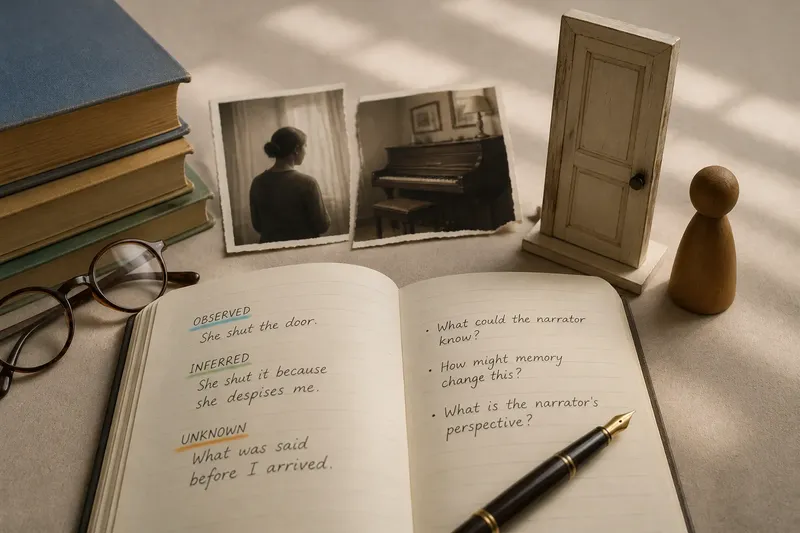
The most common mistake in reading an unreliable narrator is to treat every mismatch as a lie. That shortcut can flatten a story: a narrator who misunderstands a scene is not necessarily trying to fool you, and the distinction changes what you notice about the character, the plot, and the voice. To read an unreliable narrator well, track what the person could know, remember, and perceive before deciding what to believe.
Unreliability is a gap between a narrator’s account and the fuller reality a story lets readers infer. Deliberate lying is one cause, but not the only one. A narrator may sincerely report a mistaken belief, omit what they cannot face, or describe events through a perspective too narrow to catch their meaning. The practical task is to identify the kind of gap, then see what the story makes of it.
What kind of account are you reading?
Start by separating three things that often get bundled together: the events, the narrator’s account of them, and your interpretation of the account. A narrator can be mistaken without the story itself being unclear. Your own first impression can also be wrong without the narrator being unreliable. Keep those layers distinct as you read.
For each important scene, ask what the narrator states, what they infer, and what remains outside their view. “She shut the door” is an observable event in the account. “She shut it because she despises me” is an interpretation. If the narrator presents the second statement as certain, the story may invite you to question the certainty, not the door.
Make a small note in the margin or a reading journal. Use three labels: observed, inferred, and unknown. This is not a verdict on the narrator’s character. It is a way to keep evidence from blending into assumption.
Could the narrator have known this?
Check the narrator’s access before judging accuracy. A first-person narrator can report what they saw, heard, or were told, but cannot directly know another person’s private thoughts unless the story supplies a reason for that knowledge. A close third-person narrator may stay near one character’s awareness, while a more distant narrator can move across settings or minds. Notice when that access changes.
Limited knowledge often produces an account that is incomplete rather than deceptive. A child may describe an argument without understanding its stakes. A visitor may mistake a household custom for hostility. Someone arriving late may confidently explain a decision whose earlier discussion they missed. The account can be sincere and still leave readers with a false picture.
Look for small signals of access: “I heard,” “I assumed,” “no one told me,” or a shift from what a character notices to what another character does. Those phrases set boundaries around knowledge. If the narrator reports an unseen conversation, ask whether the text has established how they learned of it. If it has not, mark the information as uncertain rather than instantly calling the narrator a liar.
Does memory change the account?
Memory is not a recording played back without alteration. A narrator recalling an earlier event may compress time, mix up sequence, or fill a gap with what seems likely now. The account can feel honest because the narrator believes it. Watch for hesitations, corrections, repeated scenes, and details that become more certain each time they are retold.
Separate a memory error from a deliberate revision. A narrator who says, “I think the conversation happened before the storm,” signals uncertainty. One who insists on a precise sequence despite contradictory details may be protecting a version of events, but that is still an interpretation to test against the text. The writing may show confusion, defensiveness, or both.
Pay attention to what the narrator remembers vividly and what passes quickly. A striking description does not make an account more accurate; a bland omission does not prove concealment. Instead, ask what the selection of detail reveals about the narrator’s concerns. Is the remembered scene organized around embarrassment, fear, affection, or a desire to look reasonable?
Is perspective narrowing the meaning?
A narrator’s perspective includes more than physical location. It also includes vocabulary, experience, loyalties, and assumptions. A person may accurately report a gesture yet misread its meaning because they expect rejection. Someone invested in a family’s reputation may describe a painful exchange as ordinary. The facts on the page and the narrator’s explanation of them can pull in different directions.
To test for this kind of distortion, compare the explanation with the behavior surrounding it. If a narrator says a friend is merely tired, but repeatedly describes that friend avoiding conversation, the account may be showing a belief the narrator cannot revise. Don’t rush to decide whether the character is lying to you, lying to themselves, or simply missing a cue. First record the discrepancy and its source.
Then notice whether the narrator’s perspective changes. New information may correct an earlier assumption, or the narrator may keep explaining away evidence. A change can show learning; continued certainty can show denial. Either way, the movement of the account matters as much as the initial mistake.
What clues separate a lie from a mistake?
No single clue settles the question. Build a case from several signals, and leave room for ambiguity when the story does. A useful reading sequence is:
- Quote the claim. Write down the exact statement that seems unreliable, rather than paraphrasing it as “the narrator lied.”
- Identify its source. Decide whether it reports a direct observation, a memory, a secondhand account, or an inference.
- Check the narrator’s access. Ask whether they could have seen, heard, or learned the information at that point in the story.
- Compare the account with other details. Look at later events, another character’s response, or a repeated description that complicates the claim.
- Consider motive and awareness separately. Ask whether the narrator benefits from the claim, and whether the text suggests they know it is false. Benefit alone does not prove intentional deception.
- Revise your reading with care. Label the claim as false, mistaken, incomplete, or unresolved only when the evidence supports that distinction.
Imagine a narrator says their sister never objected to selling the family piano. Earlier, the narrator describes her leaving the room whenever the sale comes up; later, a note shows that she asked to keep it. That invented situation gives you evidence against the narrator’s claim, but not yet proof of a conscious lie. Perhaps the narrator forgot, dismissed the objection as unimportant, or is deliberately concealing it. The next useful question is whether the story shows awareness of the note and a choice to contradict it.
How should you handle a doubtful passage?
What if the narrator sounds completely certain?
Confidence is part of the voice, not independent proof. Set the certainty beside what the narrator can actually know and the details the story supplies. A firm statement may reveal conviction, self-protection, or simply a limited habit of interpretation.
Can a narrator be unreliable without intending to mislead?
Yes. Limited access, mistaken assumptions, gaps in memory, and emotional pressure can all produce an account that differs from the story’s implied reality. Intention matters when you are deciding whether the narrator lies, but it is not required for the account to be unreliable.
What does an unreliable narrator make the reader do?
The reader compares statements with details, notices the narrator’s limits, and keeps open questions open. That work should come from evidence in the text, not from treating every sentence as a trick. A story can ask for careful attention without turning into a puzzle with a secret answer.
When should you stop trying to settle the truth?
Stop when the text offers competing explanations but no clear way to choose among them. Record what each reading explains and what it leaves unresolved. Ambiguity can be part of the story’s design, not a problem you have failed to solve.
What is not worth the effort?
It is rarely useful to label the narrator “trustworthy” or “untrustworthy” once and apply that label to every sentence. Reliability can vary by subject and moment. A narrator may recall a room accurately but misread a friend, or admit one mistake while hiding another.
Don’t treat every omission as a clue to a secret plot. Stories leave things out because a narrator has limited attention, because a scene does not require every detail, or because the prose is keeping its focus. Look for a pattern that affects interpretation before building a theory around a single missing fact.
Nor do you need to diagnose the narrator or invent a hidden motive for every inconsistency. Use the words and scenes the story gives you. If a motive is possible but unsupported, keep it as a possibility rather than promoting it to fact.
How can you turn the reading into a useful interpretation?
Once you have tracked a few discrepancies, ask what the gap accomplishes. Does limited knowledge make the reader share a character’s confusion? Does faulty memory show how a past event has changed in the telling? Does a narrow perspective expose a bias the narrator cannot name? Connect the technique to the story’s effect, rather than stopping at “this narrator is unreliable.”
When writing a response, state the claim, name the kind of limitation, and point to the textual evidence. For example: “The narrator’s account of the argument is incomplete because they were absent for its beginning; the later recollection supplies details that revise their first explanation.” That form distinguishes what the text establishes from what you infer.
The unreliable narrator is not always a liar, and the distinction is useful because it keeps your reading precise. Follow the account’s access, memory, and perspective before judging intent. When you return to the passage, keep one question in view: what does this narrator believe, what can they know, and what does the story let you see beyond them?